
Contents+
Quick answer
- What they are: Solid fabric squares held under your chin to compare colors
- Home kit: Usually 20 to 40 drapes, well under $100
- Pro set: 100+ test drapes, can cost thousands
- Key comparisons: Warm vs cool, light vs deep, bright vs soft
- No kit: Digital drapes from a selfie, free in Color Lab
Color analysis drapes are large squares of solid-colored fabric that you hold under your chin, one at a time, to see which colors make your face look clearer and which make it look tired. Analysts use them to find your color season by comparing pairs: warm against cool, light against deep, bright against soft. You can buy a home drape kit, borrow one from a professional set, or use digital drapes on a selfie.
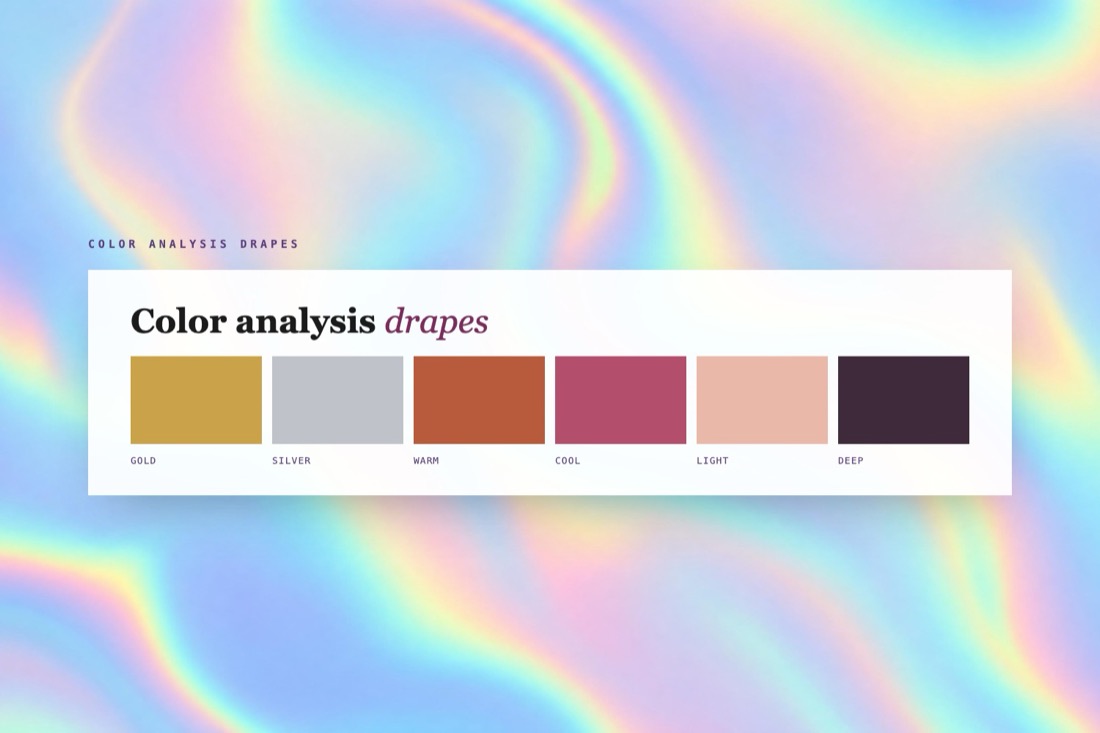
How to drape yourself for color analysis at home
- 1Sit by a window in daylight with no makeup and your hair covered by a white towel.
- 2Compare a gold drape against a silver drape to find your temperature.
- 3Compare a light and a deep drape in your winning temperature.
- 4Compare a bright drape against a soft, muted one.
- 5Photograph each drape from the same spot and compare the photos in pairs.
What color analysis drapes are
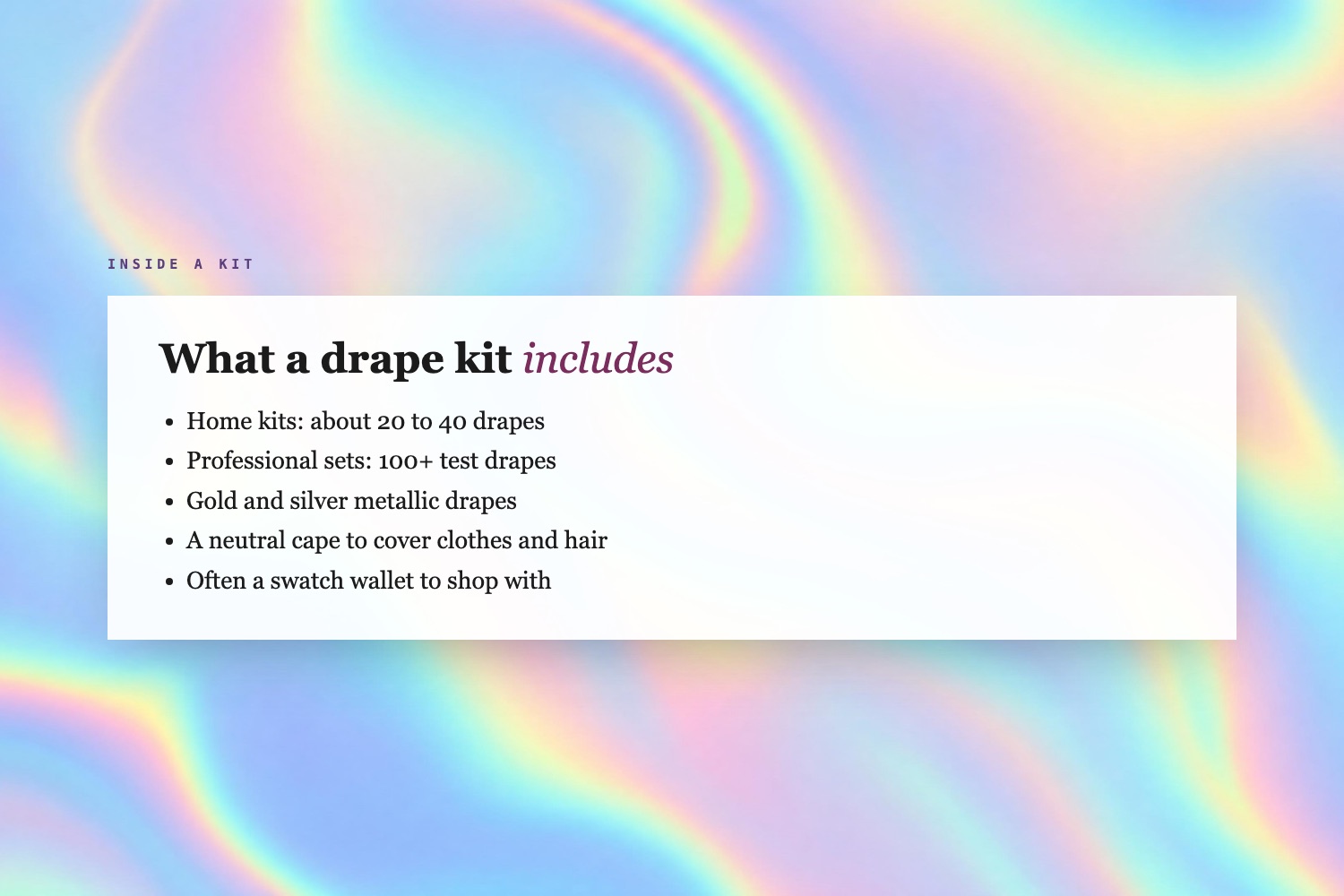
A drape is a piece of fabric big enough to cover your shoulders and the area under your chin, usually a matte cotton or polyester in one solid color. The size matters. A small swatch shows you the color, but a drape fills the space around your face, so the light bouncing off it changes how your skin looks. That's the whole effect a color analysis reads.
Drapes come in sets built around a system. A four-season set compares the four families. A 12-season set has drapes for each of the 12 seasons, often a few per season, so the analyst can narrow you from Autumn to Soft, Warm or Deep Autumn. Some sets add metallic gold and silver drapes, which are the fastest single test of warm against cool.
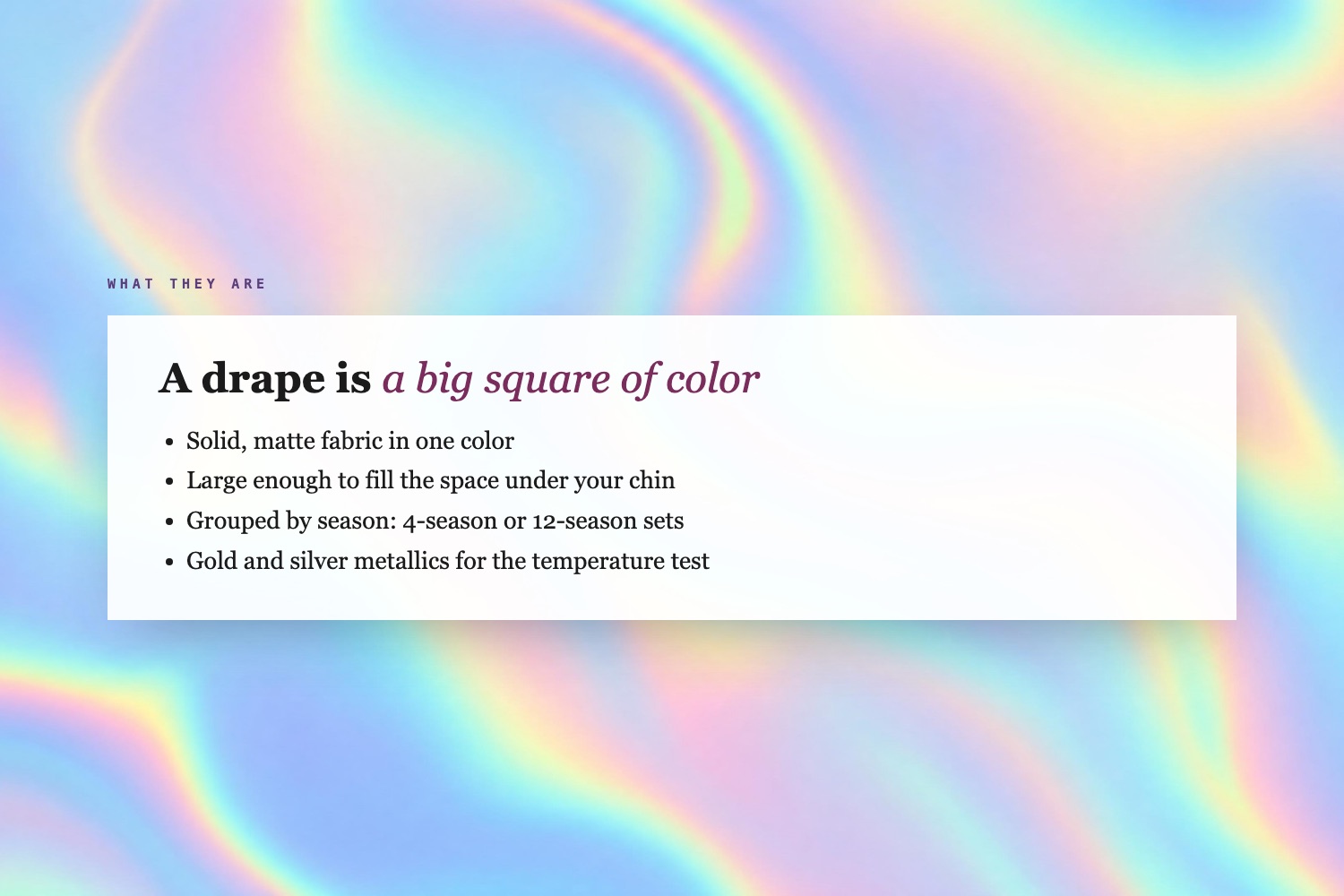
What's in a color analysis drape kit
Kits split into two kinds, and the difference is mostly how fine the comparisons can get.
- Home kits. Usually 20 to 40 drapes covering the main warm, cool, light, deep, bright and soft tests, with a printed guide or a shopping card. Most cost well under $100.
- Professional test drapes. Sets of 100 or more drapes, often several per season, dyed to tight standards so every analyst using the system sees the same colors. These can cost thousands and are usually sold with training.
- Metallic drapes. A gold and a silver lamé drape, the quickest temperature test. Many kits include them.
- Neutral cape. A white or grey cape to cover clothes and dyed hair, so nothing but the drape sits near your face.
- Swatch wallet. Some kits and most in-person sessions end with a small fan of your season's colors to take shopping.
| Option | Typical drapes | Best for |
|---|---|---|
| Home drape kit | 20 to 40 | Trying draping yourself with a friend |
| Professional test drapes | 100+ | Analysts and in-person sessions |
| In-person session | The analyst's full set | Live draping and a swatch wallet |
| Digital drapes (Color Lab) | Unlimited, on a selfie | A free, quick comparison at home |
| Yuree AI analysis | None needed | A full season report from a selfie |
How to drape yourself at home
Draping alone is harder than it sounds, because you're judging your own face while holding fabric. A friend and a phone camera help a lot. Work slowly, and always compare two drapes side by side.
- Set up by a window in daylight, around midday, with no lamps on.
- Take off makeup and cover dyed hair with a white towel or neutral cape.
- Start with temperature: gold against silver, then a warm and a cool version of the same color.
- Then depth: a light drape against a deep one in your winning temperature.
- Then chroma: a bright, clear color against a soft, greyed one.
- Photograph every drape from the same spot and compare the photos in pairs. Keep your eyes on your skin.
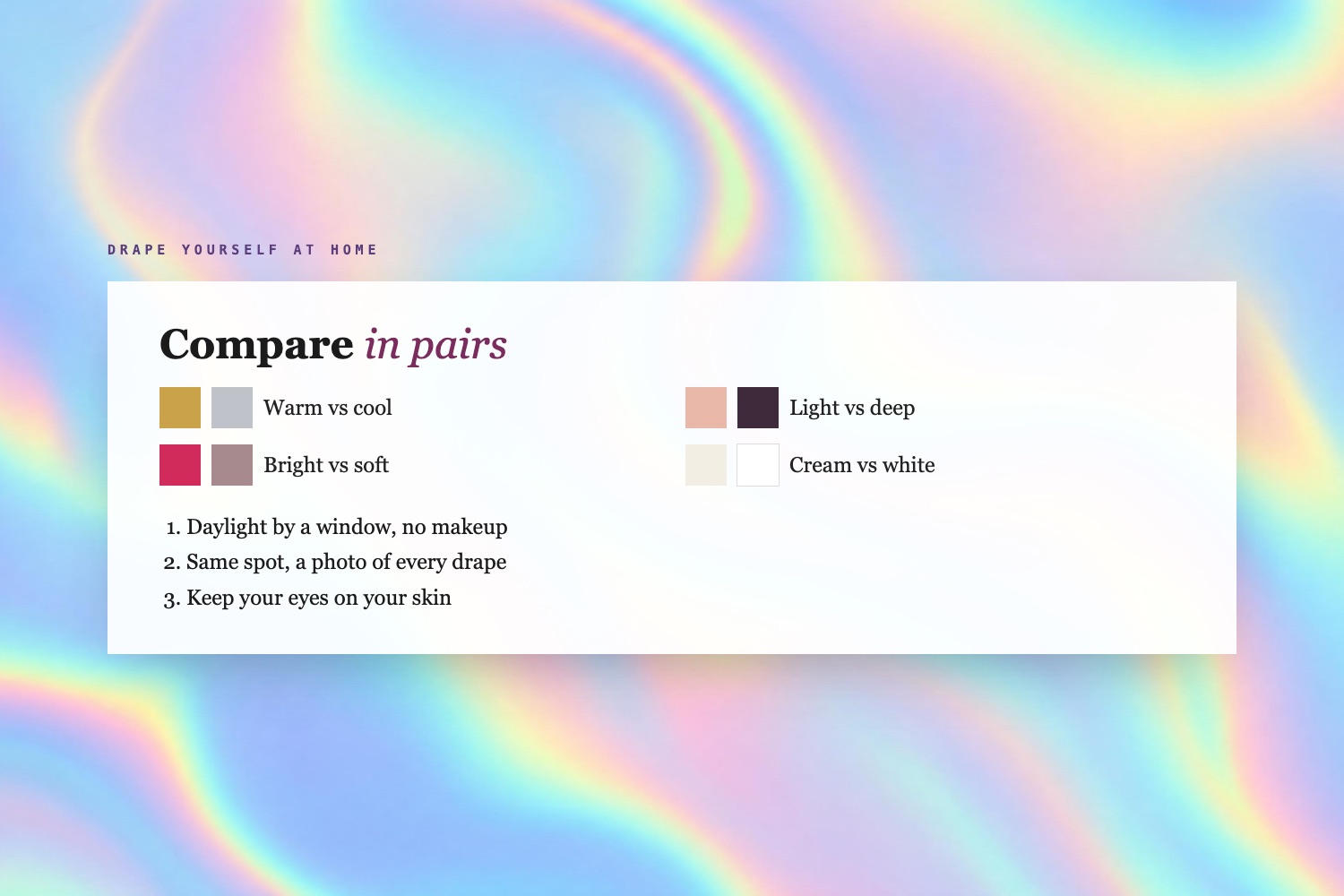
What to look for when you compare drapes
The right drape makes your skin look even and your eyes look brighter, as if you'd slept well. Shadows under the eyes soften, redness calms down, and your jawline looks sharper. The wrong drape does the opposite: it brings out dark circles, a grey or yellow cast, or blotchy red patches, and your eye goes to the fabric before your face.
Most people see the difference clearly on the first two or three pairs and less clearly after that. If two drapes look equally good, you've probably found two neighbor seasons, which is common. Our guide to color drape tests explains how analysts break those ties.
Digital drapes: draping without a kit
Digital drapes do the same comparison on a photo. You upload a selfie, and the tool puts a band of color under your face so you can flip between drapes in seconds. Yuree's Color Lab does this free, with drapes for all 12 seasons, and the photo never leaves your browser.
Digital drapes skip the setup, and they show a pair side by side on the same photo, which is hard to do with fabric. Their weak point is the photo itself: warm indoor light or a filter shifts every drape. Take your selfie facing a window in daylight with no filter, and the comparison holds up well.
If you'd rather skip draping entirely, Yuree's model reads your season straight from a selfie. It's trained on 1M+ real expert color analyses and agrees with a $200+ in-studio reading 9 out of 10 times, and the report lists your named shades, makeup, hair colors and the colors to avoid.
Quick answers
Common questions.
What are color analysis drapes?+
Color analysis drapes are large squares of solid-colored fabric held under your chin to see which colors make your face look clearer. Analysts compare them in pairs, warm against cool, light against deep and bright against soft, to find your color season.
Do I need drapes to do color analysis?+
No. Drapes are the classic method, but digital drapes on a selfie do the same comparison for free, and an AI analysis can read your season from a single photo.
How many drapes are in a color analysis kit?+
Home kits usually have 20 to 40 drapes. Professional test-drape sets have 100 or more, often several for each of the 12 seasons, plus gold and silver metallics.
Can I use clothes instead of drapes?+
Yes, as a rough test. Use solid tops in plain fabrics and compare them in pairs in daylight. Prints, shiny fabrics and colors that only cover your shoulders give weaker results than a full drape.
What are digital drapes for color analysis?+
Digital drapes put a band of color under your face on a photo, so you can flip between drapes in seconds. Yuree's Color Lab does this free from a selfie.
Are digital drapes as accurate as fabric drapes?+
They can be close if the photo is good. Take the selfie in daylight, facing a window, with no filter or makeup. Warm indoor light shifts every drape and makes the comparison unreliable.
Eujin Choi
Professional draper, Seoul
Eujin runs her own personal-color clinic in Seoul, where seasonal analysis began. She has draped thousands of clients in person, and that hands-on read of how real fabric falls on real skin is what shapes everything she writes here.
Further reading